When it comes to passport and visa applications, one of the most overlooked but crucial details is the photograph. Yes, that tiny square or rectangle that seems so simple can actually make or break your application. A rejected photo can delay your travel plans for weeks—or even months! But what exactly is not allowed in passport and visa photos? Let’s dive in and break it down in a friendly, easy-to-understand way.
Why Passport and Visa Photos Are So Strict
Passport and visa photos might seem like a minor formality, but they play a crucial role in identifying individuals accurately. Every day, millions of people cross borders, and authorities rely on these photos to confirm that the person presenting the document is indeed its rightful owner. Even a small deviation, like a shadow on the face, tinted glasses, or an unusual expression, can make it difficult for immigration officers or automated systems to match the face with official records. This is why the rules are so strict—every detail matters in ensuring global security and smooth travel.
Moreover, modern passports and visas often include biometric information, which ties your photograph to digital records. Facial recognition software is becoming a standard part of border security systems in many countries. These systems analyze precise facial features such as the distance between eyes, the shape of the jawline, and the contours of the cheeks. If your photo doesn’t follow the required standards, the software may fail to recognize you, potentially causing delays, questioning, or even denial of entry. Essentially, a perfectly compliant photo ensures that both human officers and machines can quickly and accurately verify your identity.
Another reason for strict photo standards is consistency. When officials review thousands of applications daily, uniformity in photo specifications allows them to assess each application quickly and fairly. A neutral expression, proper lighting, plain background, and centered face are not arbitrary rules—they make it easier to detect fraudulent documents, impersonation, or errors. Without these guidelines, verifying identity could become inconsistent and unreliable, creating security risks at international borders and in official government records.
Finally, strict standards also protect travelers themselves. An incorrect photo can lead to wasted time, extra fees for retakes, and even missed flights or visa opportunities. Some countries reject applications outright if the photo does not meet their specifications. Following these rules ensures your travel plans proceed smoothly and prevents unnecessary stress. So, while it might feel like nitpicking, these seemingly strict requirements exist to safeguard everyone—from the individual traveler to the global community.
Basic Requirements for Passport and Visa Photos
- The photo size should generally be 2×2 inches, although specific dimensions may vary depending on the country.
- The background must be plain, usually white or off-white, with no patterns, textures, or shadows.
- Your facial expression should be neutral, with your mouth closed and eyes relaxed; exaggerated smiles or frowns are not allowed.
- Both eyes must be fully open and clearly visible, without sunglasses, colored lenses, or any obstructions.
- Your head should be positioned straight and facing directly towards the camera, not tilted or turned to the side.
- Lighting must be even across the face and background, avoiding shadows, glare, or bright spots that obscure facial features.
- Your full face should be visible, from the bottom of the chin to the top of the forehead, without hair or accessories covering any part.
- No digital filters, heavy retouching, or photo manipulations are allowed; the photo must represent your natural appearance.
- Clothing should be simple and not blend with the background; avoid white shirts or overly bright patterns that distract from your face.
- Glasses, if allowed in your country, must have clear lenses with no reflections, glare, or frames covering the eyes.
- Headwear is generally not permitted except for religious reasons, and even then, your full face must remain visible.
- Jewelry should be minimal and not cover or distort facial features, avoiding large earrings, necklaces, or headpieces.
- Children’s photos should follow the same rules, ensuring eyes are open, face fully visible, and expression neutral, even for infants.
- The photo should be high-resolution, in focus, and printed or submitted digitally according to the country’s specifications, without pixelation or blurriness.
- Overall, the goal is to create a clear, accurate, and easily verifiable image that allows both human officers and automated systems to identify you reliably.
Common Things Not Allowed in Passport and Visa Photos
| Item | Why It’s Not Allowed | Description | Examples | Tips |
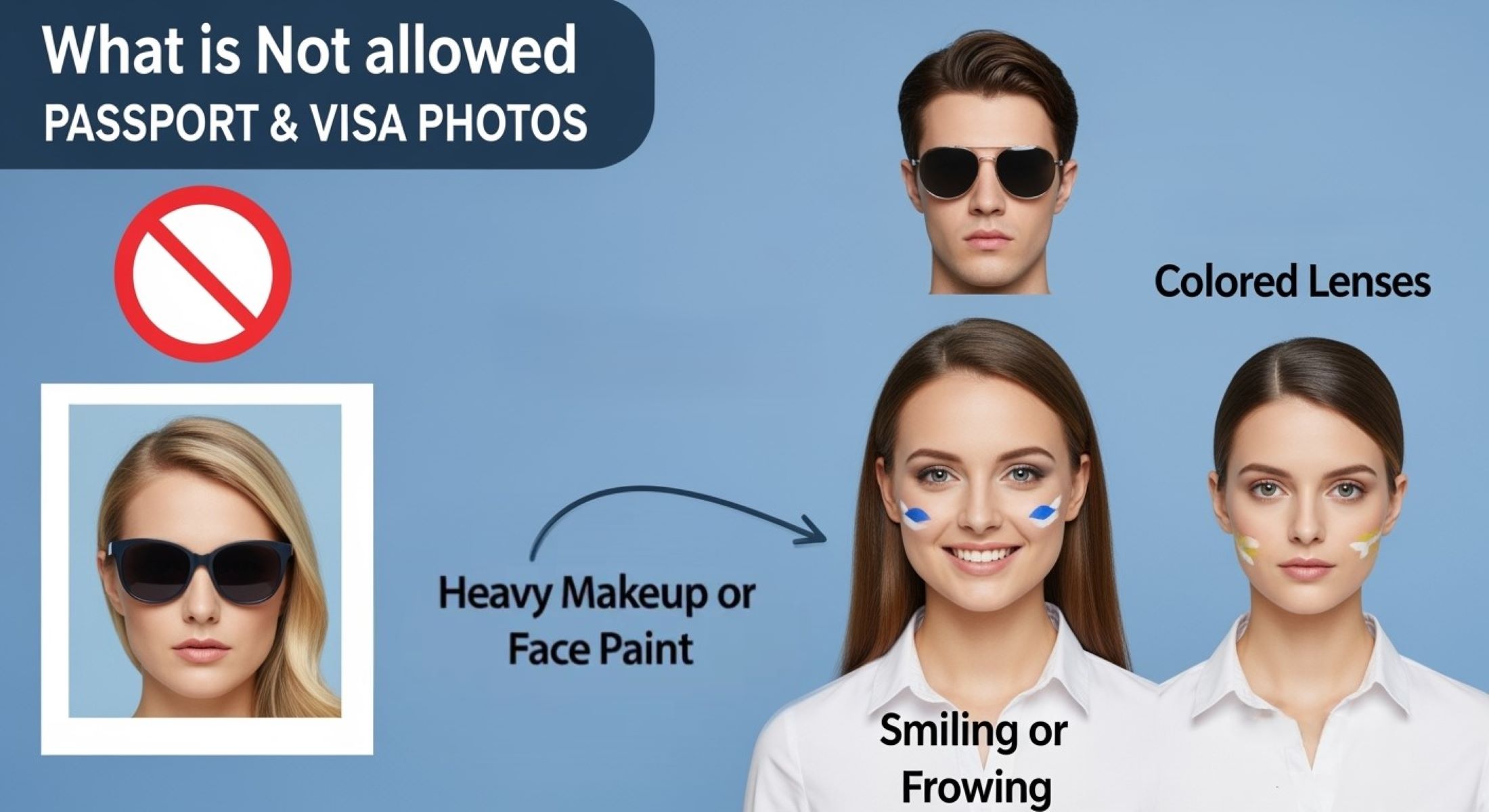
| Sunglasses and Colored Lenses | Obstruct eyes, key for identity verification | Sunglasses hide the eyes, preventing facial recognition | Dark sunglasses, tinted lenses | Wear clear prescription glasses if necessary; ensure no glare, reflections, and eyes fully visible |
| Headwear | Covers face, interferes with identification | Hats, caps, hoods block parts of the face | Baseball caps, hoodies | Only religious head coverings allowed; face must be fully visible from chin to forehead |
| Heavy Makeup or Face Paint | Alters natural facial features | Excessive makeup changes appearance enough for rejection | Bright lipstick, heavy foundation, face paint | Keep makeup natural and light; avoid altering facial contours |
| Smiling or Frowning | Facial recognition requires neutral expression | Expressions like smiling or frowning distort facial features | Open-mouth smile, exaggerated frown | Maintain closed mouth, relaxed eyes, and neutral expression |
| Hair Covering the Face | Obscures key facial features | Bangs or hair over eyes block the forehead, eyebrows, and jawline | Long bangs, stray hair strands | Ensure hair is tucked behind ears and eyes fully visible |
| Colored or Patterned Backgrounds | Distracts from face, complicates verification | Backgrounds other than plain can interfere with identification | Bright colors, patterns, textures | Use plain white, off-white, or light gray (if allowed) |
| Shadows on Face or Background | Makes identification difficult | Shadows obscure facial features, affecting recognition | Uneven lighting, overhead shadows | Use even, soft lighting with no harsh shadows or reflections |
| Digital Alterations | Changes appearance, can be seen as falsified | Editing like retouching or filters distorts features | Skin smoothing, enlarging eyes, reshaping face | Submit natural, unedited photo |
| Jewelry and Accessories | Can obscure facial features | Large or prominent items may cover parts of face | Big earrings, nose rings, glasses chains | Keep jewelry minimal and unobtrusive; avoid accessories touching the face |
| Pets, Objects, or Props | Interferes with clear facial identification | Faces must be alone without distractions | Pets, toys, phones | Ensure only your face appears in the photo; no props |
Country-Specific Restrictions
While most passport and visa photo rules are fairly universal, each country often has its own additional requirements that can differ significantly from global standards. These rules can relate to photo dimensions, facial visibility, or even how children and infants should appear in their pictures. Ignoring these country-specific rules can result in delays, application rejection, or even the need to retake photos multiple times. Therefore, understanding the nuances of the country you are applying to is just as important as following general photo guidelines.
For instance, in the United States, since November 2016, wearing glasses in passport photos has been completely prohibited. This rule aims to eliminate potential glare or reflections that obscure the eyes, ensuring that facial recognition systems and border officials can clearly see every individual’s eyes. Even prescription glasses with clear lenses are not allowed, which has caught many applicants off guard. This demonstrates how a seemingly small difference in rules between countries can have a major impact on your application process.
In the United Kingdom, the rules focus more on children and infants. Photos of babies must show their eyes open, fully visible, and facing forward, which can be challenging since infants rarely cooperate during photo sessions. Pacifiers, toys, or any objects that might obscure the child’s face are strictly forbidden. This requirement ensures that the child’s facial features are captured clearly for identification purposes, even at such a young age. Parents often find this rule stressful, but it highlights the attention to detail that different countries enforce.
India also has its own specifications, particularly for young children. Children under the age of five must have a neutral expression and face the camera directly, similar to adult requirements. However, extra care is required to ensure that the child’s entire face is visible without hair or accessories interfering. While some countries may be lenient with minor deviations for infants, India’s guidelines are precise and must be followed to avoid rejection. The key takeaway is that always checking the official guidelines of the country you’re applying to is essential to prevent costly mistakes or delays.
Tips for a Perfect Passport or Visa Photo
- Choose a professional photographer or passport photo studio that is familiar with the official rules and specifications to ensure compliance.
- Avoid taking selfies or casual phone photos, as they often fail to meet the required standards for size, lighting, and background.
- Wear neutral clothing that does not blend with the background; avoid white shirts or bright patterns that distract from your face.
- Prefer dark or solid colors for clothing to create a clear contrast against the background.
- Ensure your hair is neatly arranged, away from your forehead and eyes, so your full face is visible.
- Maintain a natural, neutral facial expression with a closed mouth and relaxed eyes.
- Keep jewelry minimal and unobtrusive, avoiding large earrings, necklaces, or accessories that touch or cover your face.
- Pay close attention to lighting, using soft, even illumination that eliminates shadows on your face and background.
- Avoid overhead lighting that can create harsh shadows or distort facial features.
- Whenever possible, use natural daylight, which provides balanced and flattering lighting.
- Take multiple photos, ideally three to five, to select the one that best meets all requirements.
- Make sure your face is centered in each photo, with the head and shoulders properly aligned.
- Carefully check each shot for reflections, glare, stray hairs, or shadows that might obscure facial features.
- Verify that the background is plain, consistent, and free from any patterns, textures, or objects that could distract from your face.
- Ensure the final photo is high-resolution, sharp, and clearly represents your natural appearance without digital editing or filters.
How to Avoid Photo Rejection
| Item | Reason | What to Check | Common Mistakes | Tips |
| Neutral Facial Expression | Facial recognition systems require a natural look | Mouth closed, relaxed eyes, no smile or frown | Smiling, frowning, exaggerated expressions | Keep a calm, neutral look; practice in front of a mirror |
| No Sunglasses or Tinted Glasses | Eyes must be fully visible for identity verification | Remove all glasses or use clear lenses if allowed | Wearing sunglasses or colored lenses | Check country-specific rules; no glasses in US photos since 2016 |
| Hair Off Face | Hair can obscure facial features | Hair tucked behind ears, forehead visible | Bangs over eyes, messy hair covering face | Use hair clips or comb hair back before taking photo |
| Plain Background | Distracting backgrounds cause rejection | White or off-white, no patterns, textures, or shadows | Colored or patterned backgrounds | Ensure even lighting and plain backdrop |
| Even Lighting | Shadows obscure facial features | Soft, balanced lighting on face and background | Harsh overhead lights, shadows, glare | Use natural daylight or soft artificial lighting |
| Minimal Jewelry | Jewelry can cover facial features | Only small, unobtrusive pieces | Large earrings, necklaces, or headpieces | Remove or reduce jewelry; avoid anything touching the face |
| Correct Head Position | Must be straight and facing camera | Head upright, shoulders straight | Tilted head, turned slightly | Center your head; align shoulders with camera |
| No Digital Alterations | Editing distorts natural features | Submit unedited, natural photo | Filters, Photoshop, skin smoothing | Use original photo only; avoid apps that change appearance |
| Proper Photo Size | Incorrect dimensions lead to rejection | Follow country-specific size requirements | Too small, too large, cropped incorrectly | Measure or confirm photo size before submission |
| No Objects or Pets | Must focus solely on the applicant’s face | Face alone, no distractions | Holding pets, toys, phones, or props | Keep photo clean; ensure only your face is visible |
The Hidden Pitfalls That Can Ruin Your Passport Photo
Even if you follow the obvious rules, there are subtle mistakes that many applicants overlook, and these can lead to rejection. One common issue is improper posture. Sitting or standing slightly off-center, tilting your chin, or leaning forward can distort the facial proportions, making it harder for officials and facial recognition systems to identify you. Many people assume a casual, relaxed stance is fine, but even a small angle can result in an unacceptable photo.
Another frequently overlooked problem is the influence of lighting and shadows. Harsh light or uneven illumination can create deep shadows on your face or background, which may conceal essential facial features. Glare from glasses or shiny skin is another culprit. Even if your photo meets all other requirements, shadows and reflections can lead to automatic rejection by digital verification systems that are designed to detect inconsistencies.
A less obvious pitfall is wearing clothing or accessories that merge with the background or reflect light. White shirts against a white background, metallic jewelry, or shiny hairpins can confuse the camera or automated systems, making your face less distinguishable. Many applicants focus solely on the face, forgetting that the surrounding visual elements can affect the overall compliance of the photo. Choosing colors that contrast with the background helps ensure that your facial features stand out clearly.
Finally, attention to children and infants is often underestimated. Babies and toddlers may move unpredictably, resulting in closed eyes, blurred images, or improper head positions. While adults are expected to maintain a neutral expression, children may require several attempts and careful handling to achieve a photo that meets regulations. Understanding these hidden pitfalls—and preparing for them—can save significant time, stress, and money during the passport or visa application process.